All About Benelux
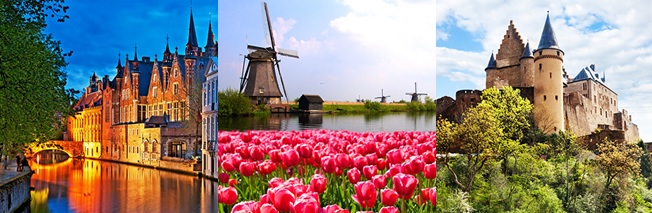
The Interrail Benelux Pass is a unique "One Country Pass" that provides access to three distinct European countries for the price of one: Belgium, the Netherlands, and Luxembourg. This pass is designed to explore the incredible history, scenic countryside, and world-class rail networks of the Benelux region seamlessly.
The Benelux Combo: Three Countries, One Pass
The beauty of traveling through the Benelux region by train lies in its variety, geographic proximity, and efficient transit links. With a single pass, you can experience:
- The Netherlands: Renowned for its iconic windmills, vibrant tulip fields, expansive cycling paths, and historic canal-woven cities like Amsterdam, Rotterdam, and Utrecht.
- Belgium: A paradise for food and architecture lovers, boasting medieval gems like Bruges and Ghent, alongside the cosmopolitan European capital of Brussels.
- Luxembourg: Famous for its dramatic cliffside fortifications, fairy-tale castles, and deep river valleys nestled within the Ardennes.
Trains You Can Travel on with the Benelux Pass
The Interrail Benelux Pass grants you unlimited travel on the national railway networks of all three countries, as well as several prominent regional and private rail lines:
1. National Railway Networks (No Reservations Needed)
For the vast majority of local, suburban, and regional trains in the Benelux region, you do not need to book your seats in advance. You simply activate your travel day on the Interrail app, hop on any scheduled train, and show your digital pass to the conductor.
- NS (Nederlandse Spoorwegen): The national railway of the Netherlands. Covers all domestic Intercity and Sprinter trains.
- SNCB/NMBS: The national railway company of Belgium. Covers all domestic InterCity (IC), Local (L), and Regional (P) trains.
- CFL (Société Nationale des Chemins de Fer Luxembourgeois): The national railway of Luxembourg. Covers all domestic trains and cross-border trains operated by CFL. (Note: While 2nd class public transit is completely free within Luxembourg for everyone, the pass remains highly valuable for 1st class upgrades or crossing the borders into Belgium and the Netherlands).
2. Regional & Private Operators Included
The pass also covers domestic regional routes operated by other private companies within the network:
- Arriva, Blauwnet, Breng, DB Regio, and Valleilijn trains operating regional lines inside the Netherlands.
3. Cross-Border & High-Speed Trains (Reservations Required)
If you want to move quickly between major hubs or travel on premium high-speed trains, you can use your pass, but you will need to purchase a separate seat reservation fee:
- Eurostar (formerly Thalys): You can use your Benelux Pass on Eurostar trains only for journeys operating strictly within the Netherlands and Belgium (such as the high-speed link between Amsterdam, Rotterdam, Antwerp, and Brussels). These require mandatory seat reservations and have limited pass-holder seat quotas, so booking early is highly recommended.
- ICE (Intercity Express): Operates high-speed international links between the Netherlands/Belgium and Germany (e.g., Amsterdam to Utrecht or Brussels to Liège). Reservations are optional but highly encouraged during peak summer travel periods.
- EuroCity & Intercity International: Regular international trains running between Brussels and Amsterdam, or Brussels and Luxembourg City, are fully included and typically do not require reservations, making cross-border hopping incredibly flexible.
Practical Tips for Pass Holders
- Avoid the Boundary Trap: The Interrail Benelux Pass is strictly valid inside Belgium, the Netherlands, and Luxembourg. If your train crosses into France, Germany, or the UK (such as taking a Eurostar all the way to Paris or London), your pass will not cover that portion of the journey. If you plan to expand your trip further, consider an Interrail Global Pass instead.
- Pass Eligibility: Remember that One Country Passes cannot be used in your own country of residence. If you live in the Netherlands, you cannot use a Benelux pass to travel domestically within the Netherlands, though you can use it in Belgium and Luxembourg.
- First vs. Second Class: When purchasing, you can select either a 1st or 2nd class pass. A 1st class pass gives you access to quieter, more spacious cars and allows you to sit in 2nd class if 1st class sections are unavailable or full.
France’s national state-owned railway company is the Société nationale des chemins de fer français, or French National Railway Company, (SNCF). SNCF operates the country’s national rail service including the TGV, France’s high-speed rail network.
Regional and InterCity Trains in France
The main rail network in France is made up of regional TER trains, which link most French towns and cities and operate frequent services.
InterCité (IC) trains operating the medium– and long-haul routes in France, connecting the main towns and cities. InterCités de Nuit are the night-train versions.
Domestic High-Speed Trains in France
These trains are run by TGV and travel at high speeds of 200 mph (320 kph). TGV trains transport passengers to cities across France, including from Paris to popular destinations like Bordeaux, Lyon, Marseille and Nice. TGV trains offer air-conditioning, large luggage racks, power sockets, plus refreshments and often a restaurant car.
International High-Speed Trains in France
Eurostar trains connects Paris and Lille to London via the Channel Tunnel, and Lille to Brussels.
Thalys trains links Paris to Amsterdam, Brussels, and Cologne.
There are other international high-speed services: TGV (to Belgium, Germany, and Italy), TGV Lyria (to Switzerland), ICE (to Germany), and a Renfe-SNCF joint service to Spain. Thello night trains operate from Paris into Italy.